 SimSmsBox
 Quick answer: SS7 is the decades-old signaling protocol that phone networks use behind the scenes to route calls and texts between carriers. It was built for a small club of trusted operators and has weak authentication, so an attacker with network access can, in principle, reroute or intercept SMS — including verification codes. SS7 attacks are rare and require real resources, but they’re the technical reason security experts consider SMS OTP a lower-assurance second factor than an app or hardware key.
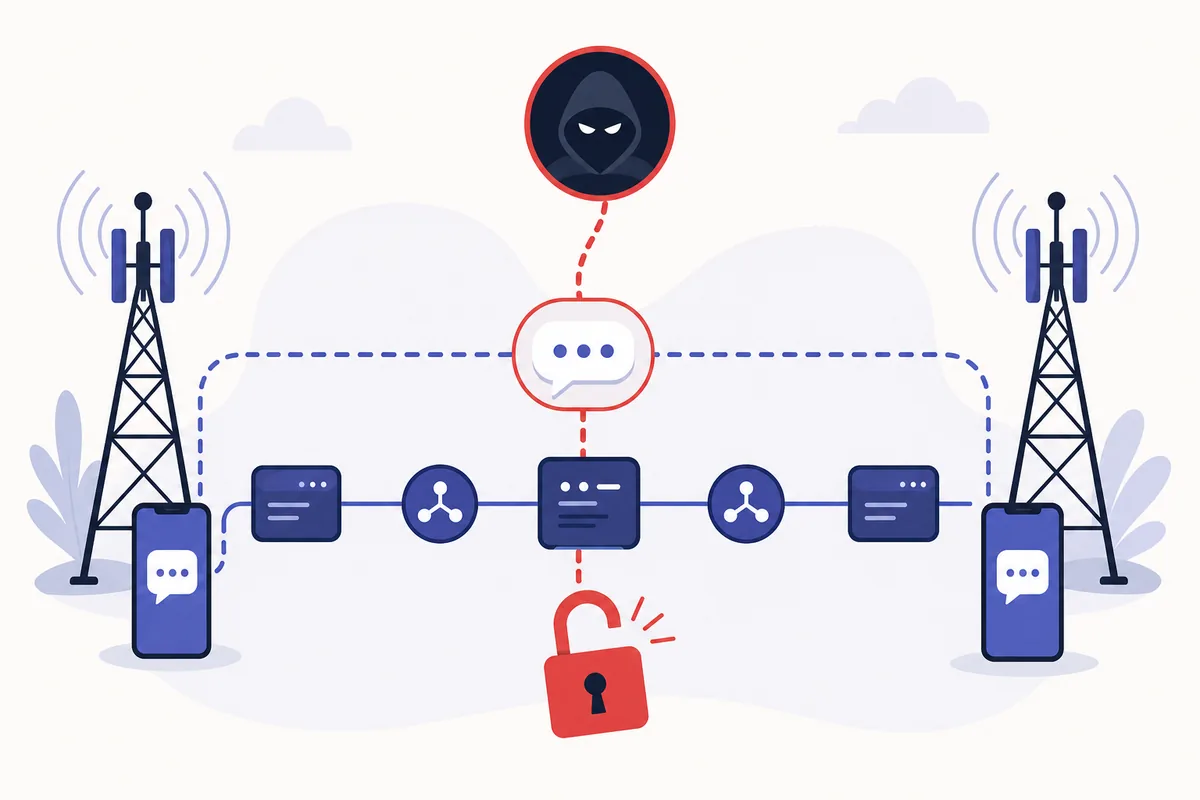
Most SMS security risks are about people — phishing, SIM swaps, scams. SS7 is different: it’s a weakness baked into the plumbing of the phone network itself. You’ll almost never be targeted this way, but understanding it explains why SMS codes sit lower on the security ladder than they feel. Here’s the plain-English version.
1. What SS7 is
Signaling System 7 (SS7) is the protocol suite carriers have used since the 1970s to set up calls, route texts, and hand off roaming between networks. When your phone gets a text from another country, SS7 is the machinery quietly making that work.
The problem: SS7 was designed when only a handful of state-run telecoms could touch it, so it largely trusts any request that reaches it. In a modern world with thousands of interconnected operators and resellers, that trust is a vulnerability — a party with signaling access can send commands the network will honor.
2. How an SS7 attack touches SMS
Because SS7 controls where messages route, an attacker with access can ask the network to deliver your texts to them — a bit like updating a forwarding address deep inside the system. If your verification code rides SMS, it can be silently copied or diverted, no malware on your phone required.
| Aspect | SS7 attack | SIM swap |
|---|---|---|
| Where it happens | Inside carrier signaling | At the carrier’s account desk |
| What’s exploited | Protocol trust | Human/process weakness |
| Visibility to you | Nearly invisible | You lose signal |
| Difficulty | High (needs network access) | Lower (social engineering) |
The upshot is the same as other code-interception risks: an SMS code is only as safe as the network carrying it.
3. How worried should you be?
For almost everyone: not very. SS7 attacks need signaling-network access and effort, so they target high-value individuals, not ordinary accounts. The everyday threats — phishing and OTP bot scams — are far more likely to affect you.
But SS7 is why standards bodies rate SMS as a weaker second factor. If an account is high-risk, layering on an authenticator app or passkey removes the network from the equation entirely. For most logins, SMS remains a reasonable, convenient factor — just not the strongest one.
4. What this means if you receive codes online
SS7 is a network-layer issue, so it applies to any SMS delivery — a physical SIM or an online number alike; neither is specially exposed by it. If you receive codes online without a SIM, the practical guidance is the same as for any phone: use SMS codes freely for routine logins, and prefer an app-based factor for your most sensitive accounts.
The realistic takeaway isn’t “SMS is unsafe” — it’s “SMS is convenient and fine for most things, while the crown jewels deserve a factor that doesn’t travel over the phone network at all.”
FAQ
Q: Can an SS7 attack read my texts without touching my phone? In principle yes — it operates inside carrier signaling, so no device compromise is needed. But it requires network access most attackers don’t have.
Q: Does an SS7 attack affect online numbers more than a SIM? No. It’s a network-level weakness affecting SMS delivery generally; online numbers aren’t specially targeted by it.
Q: How do I avoid SS7 risk entirely? Use a second factor that doesn’t rely on SMS at all — an authenticator app, passkey, or hardware key — for high-value accounts.
Takeaway
SS7 is the trusting old signaling backbone of phone networks, and its weak authentication is the technical reason SMS codes can, in rare cases, be intercepted in transit. It’s not a threat most people will meet, but it’s why SMS is rated a lower-assurance factor — convenient for everyday logins, while your most sensitive accounts are better off with a factor that never travels over the network.