 SimSmsBox
 Short answer: There is no single way to “get a virtual number” — there are four, and they are not interchangeable. A carrier second line or eSIM, a VoIP app, a one-time number from an SMS platform, or a rented dedicated number. Decide how long the number must live and whether it must receive codes before you pay for one.
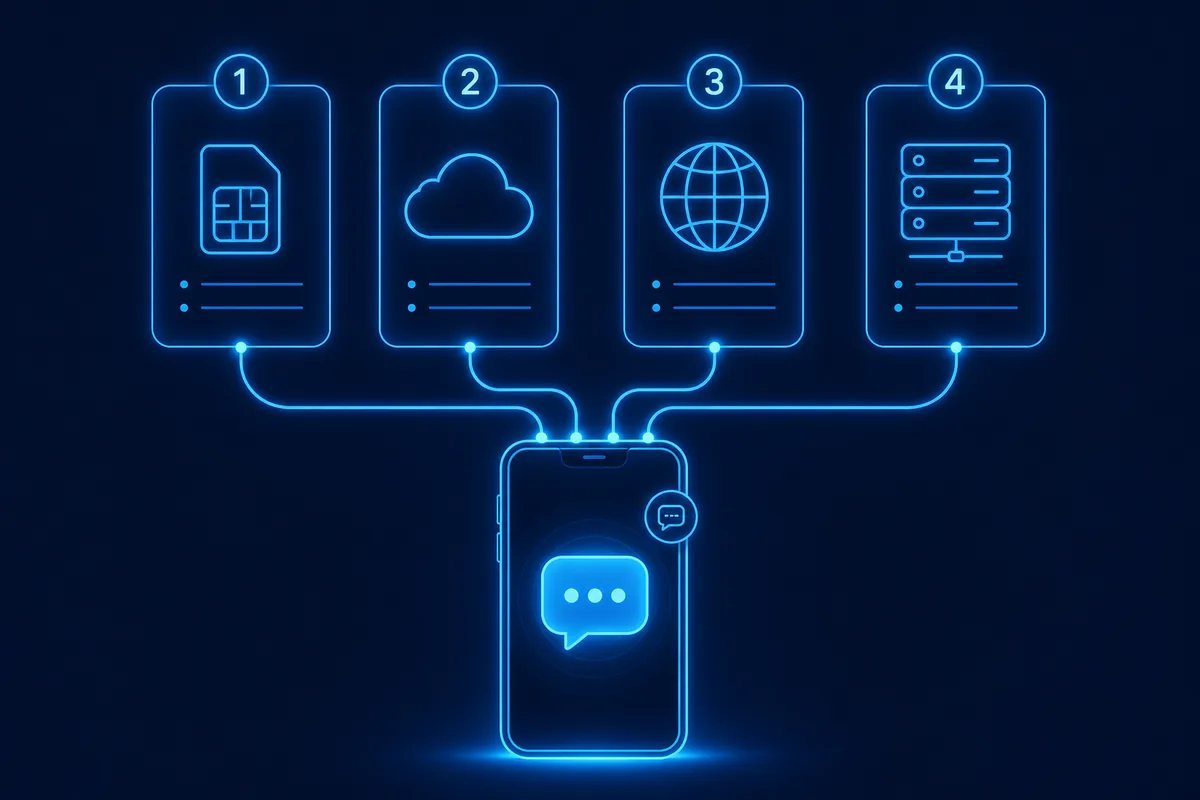
Most people arrive at this question from a concrete wall: an app wants phone verification, and the number in your pocket either can’t be used or shouldn’t be. The four routes differ in cost by an order of magnitude, so start with one question — do you need this number for one minute or for one year?
The four routes, side by side
| Route | How you get it | OTP success rate | Lifespan | Rough cost |
|---|---|---|---|---|
| Carrier second line / eSIM | Add a line in your carrier’s app | High | Long term | Monthly fee, ID required |
| VoIP app | Sign up for Google Voice, Skype Number, etc. | Low to medium, often refused | Long, but reclaimable | Free to cheap |
| One-time platform number | Rent a number per code on an SMS platform | Medium to high, depends on sourcing | Minutes | Cents per use |
| Dedicated rented number | Lease an exclusive number by day or month | High | Days to months | Clearly more than one-time |
What decides the outcome is never the word “virtual” — it’s the number range underneath. What is a virtual phone number and what is a non-VoIP number cover that mechanism.
Route 1: carrier second line or eSIM
If you need a number that can safely hold a real account, this is the only solid option. Most carriers now sell a second line, and eSIM lets you provision it without touching hardware.
- Upside: the line is a normal on-network number in the carrier’s HLR, so apps almost never refuse it.
- Downside: identity checks, a monthly bill, and you generally cannot pick a foreign country.
If eSIM is your plan, read can you use an eSIM to receive SMS codes first.
Route 2: VoIP apps
Google Voice, Skype Number and similar services are the cheapest to obtain, which is why they’re the first idea. The problem is that their ranges are widely tagged as VoIP, and finance, rideshare, and most social apps reject them outright.
Fine as a calling identity or a work line. Unreliable as a verification line. The boundaries are in can you use Google Voice for SMS verification.
Route 3: a one-time number from an SMS platform (fastest)
If you just need one code delivered, this is the least work. The flow is four steps:
- Register and top up. Billing is per code, so a small balance is enough to test.
- Pick the country and the target service — say “US + Telegram”. The service selector matters: platforms route you to ranges that still pass that app’s checks.
- Take the number and paste it into the app’s verification field.
- Read the code on the platform. It usually lands within a minute. If it times out, release the number and take a new one instead of retrying on the same line.
Full walkthrough: overseas SMS verification tutorial. For why one pool delivers and another doesn’t, see SMS number sourcing explained.
Route 4: a dedicated rented number
If the account will need codes again later — new-device logins, password resets — a one-time number guarantees a future lockout. The moment it returns to the pool it belongs to someone else. Lease an exclusive number instead, so nobody else sees its inbox while you hold it.
Three ways people waste money here
- Pasting a number from a “generator”. Those digits were never provisioned by any carrier, so nothing can be delivered to them. See do virtual phone number generators work.
- Country mismatch between the number and your IP. Telegram is especially strict about this.
- Using a disposable line for wallets, exchanges, or banking. Don’t. Recovery breaks the moment the number rotates — see recycled phone numbers.
If what you really want is a foreign number
The ranking changes when the requirement is a specific country. That case is covered in how to get a foreign phone number. And if you have no SIM at all, see how to receive SMS online without a SIM card.
Summary
One-off use: take a platform number. Long-term use: a carrier line, eSIM, or a dedicated rental. The free-looking VoIP middle path is the one that fails most often in verification. Pick the purpose first and the route almost picks itself.